The Dubai Tax Trap: What Digital Entrepreneurs from Germany Really Need to Consider
More and more influencers, streamers, TikTok creators, and digital entrepreneurs resident in Germany are choosing to relocate to the United Arab Emirates - above all to Dubai. The appeal is obvious: no income tax, international reach, a luxurious quality of life, and a professional environment. Yet as simple as these promises may sound - from a tax perspective, leaving Germany is fraught with many pitfalls.
As the founder of Danho und Partner Wirtschaftskanzlei LLC-FZ in Dubai, I regularly support German entrepreneurs on their way into a new, tax-optimized life. From experience, I can tell you: anyone who fails to plan properly and early on risks substantial tax claims from the German tax authorities - even years after relocating.
1. Tax Liability Despite Emigration? The 3 Most Common Mistakes
Many clients mistakenly assume that a flight to Dubai automatically makes them tax-free. Often, the opposite is the case. Three common misconceptions:
MisconceptionExplanation"I no longer have a residence in Germany"Even a guest room at relatives' or a signed rental agreement is enough for the tax office to establish unlimited tax liability."I only work internationally now"As soon as you have advertising partners in Germany, attend events, or generate income from German sources, you may still be liable to tax in Germany."My Dubai company protects me"What matters is where you make your business decisions. If you effectively run your business from Germany, tax liability shifts there.
Many German influencers technically run their companies from Dubai, but in reality contracts, content collaborations, and client conversations continue to be coordinated from Germany - often unknowingly. This "hidden place of management" is treated by the German tax authorities as a domestic permanent establishment - with all the associated tax consequences.
2. Center of Life in Dubai? How to Successfully Deregister for Tax Purposes
To permanently break free from unlimited tax liability in Germany, the following requirements must be met:
- Complete abandonment of your residence in Germany (no property of your own, no room, no key, no hotel addresses)
- Demonstrable habitual abode in Dubai (e.g. rental agreement, electricity bills, bank account, Emirates ID)
- No centre of economic or family interests remaining in Germany
- Seamless travel documentation to avoid the 183-day rule
Here it pays to work with an experienced tax advisor who structures the evidentiary documentation for your tax deregistration together with you.
3. The Great Unknown: Extended Limited Tax Liability (Section 2 AStG)
Anyone who moves from a high-tax country such as Germany to a low-tax country - like the UAE - may nonetheless remain liable to tax in Germany if economic ties persist. This applies in particular to:
- Income from German real estate
- Shareholdings in German GmbHs or partnerships
- Advertising contracts with German companies
- Income from events, trade fairs, or online shops focused on German customers
Extended limited tax liability applies for up to ten years after departure. Here too, there is a tax-free allowance of €16,500, which is, however, quickly exceeded. A structured exit strategy prior to relocating can minimize these risks.
4. Dubai Freezone LLC & "Anonymous" Offshore Companies: Myth or Shield?
Many influencers set up what is known as a Freezone LLC in Dubai, usually without any real substance. They believe this structure protects them from German taxation - but that is only the case if the following conditions are met:
ConditionConsequenceThe company has its own staff and a physical office in Dubai+ Positive for proof of substanceOperational management lies entirely abroad+ No retroactive tax effect for GermanyClients are international - no longer predominantly from Germany+ Lower risk of a permanent establishment fiction
If these points do not apply - particularly in the case of so-called "letterbox companies" - the German Foreign Tax Act (Außensteuergesetz) applies. The consequence: the company's profits are notionally taxed in Germany, including controlled foreign company (CFC) taxation.
5. Exit Tax: What Shareholders of German Companies Need to Consider
Influencers who hold shares in a GmbH or UG in Germany should be particularly careful. Upon departure, Section 6 AStG (exit taxation) applies. This means:
- The tax office treats you as if you had sold your shares
- The notional capital gain is taxed immediately in Germany
- Payment can be deferred upon application - but only under strict conditions
At Danho & Partner, we develop legal models together with our clients to reduce this tax burden - for example through restructuring, holding structures, or relocation prior to the exit.
Tax Freedom in Dubai? Yes - But Only With the Right Structure
A residence in Dubai offers enormous tax potential - but anyone who keeps one foot in Germany becomes liable to tax faster than they think. As specialised tax advisors in Dubai, we offer you:
- A free initial consultation (10 minutes)
- Personal advice on your plans and your business model
- Support with a legally sound departure from Germany
- Building genuine substance structures in Dubai
- A strategy to avoid exit taxation
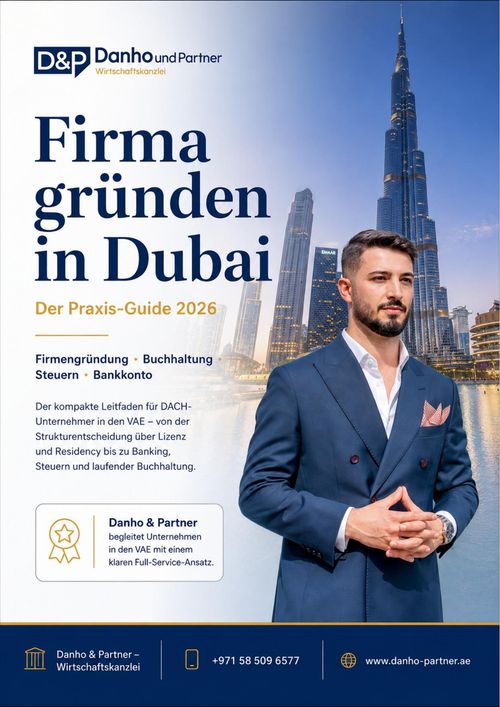
Firma gründen in Dubai 2026
25 Seiten zu Gründung, Buchhaltung, Steuern und Bankkonto in den VAE.
Mit dem Absenden stimmen Sie der Verarbeitung Ihrer Daten gemäß unserer Datenschutzerklärung zu. Abmeldung jederzeit möglich.
Talk to us
Get in touch to discuss your individual case. We offer detailed solutions tailored precisely to your needs.