Jetzt Beratungstermin buchen
A mainland company is set up with the Department of Economy and Tourism (DET) in Dubai. It can serve customers in all emirates directly, bid for public tenders and, in most sectors, be 100% foreign-owned. For tax purposes: 0% Corporate Tax on profit up to AED 375,000, 9% above, plus 5% VAT once registration is required.
Do you want to do more in Dubai than hold assets, and actually trade in the local market, with customers in all emirates, your own showroom or government contracts? Then a mainland company is usually the right basis. This page explains how a mainland LLC works, what drives the cost, how it is taxed and when a free zone is the better fit. As of October 2026.
A mainland (onshore) company in Dubai is set up with the Department of Economy and Tourism (DET, formerly DED). The legal basis is the UAE Commercial Companies Law, Federal Decree-Law No. 32 of 2021. A mainland licence lets you serve customers in all emirates directly. If you want your own premises in another emirate, you need a branch licence there.
The most common legal form is the Limited Liability Company (LLC). It has at least one and at most 50 shareholders, who can be individuals or companies. Shareholders' liability is limited to their contribution. There is no fixed statutory minimum capital for an LLC, but the authority can require a certain capital for specific activities.

For a long time a mainland LLC needed an Emirati shareholder holding at least 51% of the shares. This requirement was abolished in 2021. Today foreign shareholders can own a mainland LLC 100% in most sectors.
The exception is the so-called Strategic Impact Activities under Cabinet Resolution No. 55 of 2021. These include security and defence, banking, insurance and financial services, telecommunications, currency printing and Hajj and Umrah services. Here the authorities decide case by case on ownership and conditions.
Dubai's DET also maintains a list of more than 1,000 activities for which 100% foreign ownership is expressly permitted (the positive list). If an activity is not on the list, 100% ownership is not automatically ruled out; the authority then decides case by case. For certain professional licences, for example for sole establishments, a Local Service Agent may still be required depending on the activity. The agent holds no shares and is paid under a service agreement. We clarify what applies to your activity before the application.
| Legal form | Typical use |
|---|---|
| Limited Liability Company (LLC) | Standard vehicle for operating businesses with one or more shareholders |
| Sole Establishment | Individual with unlimited liability, mainly for professional activities |
| Branch | Mainland branch of a foreign company or of a free zone company |
You also choose the licence type that matches your activity:
Choosing the wrong activity causes problems later with banks, visas or inspections. That is why we define the activities together with you.
A mainland licence requires business premises in the emirate. The lease is registered through the Ejari system. The office size largely determines how many visas the company can apply for. Smaller companies can use business centres that offer Ejari-compliant office space. Whether that is acceptable for your activity depends on the licence type. Warehouses, showrooms and restaurants have their own requirements.
A mainland company is fully taxable in the UAE. The key points:
| Tax | Rule |
|---|---|
| Corporate Tax | 0% on taxable profit up to AED 375,000 (tax-free allowance), 9% on the portion above. Every company must register and file a tax return. |
| Small Business Relief | Available on election for companies with revenue of no more than AED 3 million in the period and all previous periods, for tax periods ending on or before 31 December 2029. Members of multinational groups are excluded. |
| VAT | 5%. Mandatory registration from AED 375,000 of taxable supplies in 12 months, voluntary registration from AED 187,500. |
| Personal income tax | No income tax on your salary or your private investment income in the UAE. |
The former Economic Substance Regulations were repealed for periods starting after 31 December 2022. We handle the registration through our Corporate Tax registration service and the ongoing obligations through accounting in Dubai.
This is one of the most important decisions when setting up. The answer depends mainly on where your customers are.
| Criterion | Mainland | Free zone |
|---|---|---|
| Authority | DET Dubai | relevant free zone authority |
| Customers in mainland UAE | directly and without restriction | only to a limited extent or with an additional permit |
| Ownership | 100% in most sectors | 100% |
| Office | business premises with Ejari | flexi-desk or office in the zone |
| Corporate Tax | 0% up to AED 375,000, 9% above | same as mainland; 0% on qualifying income only as a Qualifying Free Zone Person |
| VAT | 5% | 5%; special rules only in designated zones for certain supplies of goods |
| Government contracts | possible | generally not directly |
Important for service providers: a free zone company that mainly serves mainland customers usually earns no qualifying income. The 0% rate then falls away and, as on the mainland, 9% applies to profit above AED 375,000. Since 2025 Dubai has also offered a permit that allows free zone companies to operate on the mainland subject to conditions. Whether that makes sense for you or whether you set up directly on the mainland depends on your business model. You can find the alternative under Dubai free zone company formation.
If you work mostly internationally, for example as an online entrepreneur, coach or agency with clients abroad, a free zone is often the simpler solution.
More on this under Dubai residency and corporate bank account in Dubai.
A flat figure would be misleading. Costs depend on the activity and licence type, government fees, rent for the premises, the number of visas, any additional approvals and the notarisation. On top of that come ongoing costs for licence renewal, bookkeeping and tax returns. In an initial consultation we prepare a transparent overview for your plans.
Danho & Partner is a German-speaking business advisory firm based in Meydan Free Zone, Dubai. For more than 7 years we have supported entrepreneurs from Germany, Austria and Switzerland, with more than 1,000 company formations.
Yes, in most sectors. The exceptions are the Strategic Impact Activities, such as banking, insurance, telecommunications or defence. We check whether your activity is affected beforehand.
In most cases you no longer need an Emirati majority shareholder. For certain professional licences a Local Service Agent may be required, who holds no shares.
At least one and at most 50. Shareholders can be individuals or companies.
Yes. A mainland licence requires business premises in the emirate with a lease registered through Ejari. The size also determines how many visas are possible.
At 0% Corporate Tax on profit up to AED 375,000 and 9% on the portion above. From AED 375,000 of taxable supplies, VAT registration is also mandatory, at a rate of 5%.
Not automatically. Free zone companies generally also pay 9% on profit above AED 375,000. The 0% rate only applies to qualifying income of a Qualifying Free Zone Person, and services to mainland customers usually do not qualify.
Want to know whether a mainland or a free zone company is the better fit for your business? Book an initial consultation with Danho & Partner. We look at your business model and recommend the structure that fits you legally and from a tax perspective.
Note: this page is for general information only (as of October 2026) and does not replace legal or tax advice for your individual case.
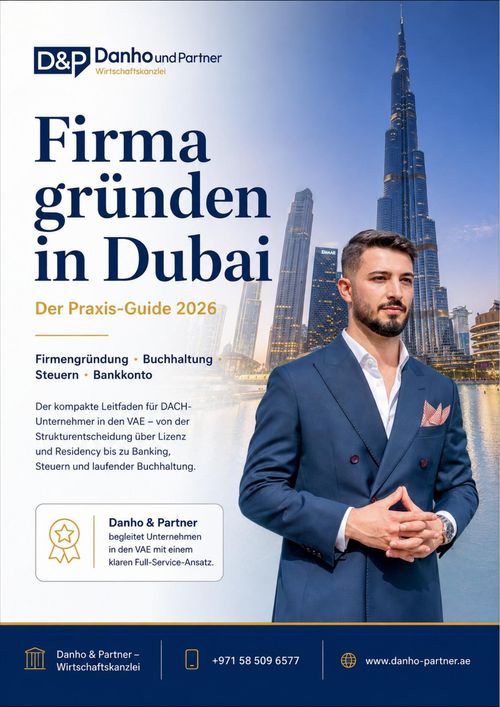
25 Seiten zu Gründung, Buchhaltung, Steuern und Bankkonto in den VAE.
Mit dem Absenden stimmst du der Verarbeitung deiner Daten gemäß unserer Datenschutzerklärung zu. Abmeldung jederzeit möglich.
Melde dich für unseren Newsletter an, um die neuesten Nachrichten, exklusive Angebote und wertvolle Erkenntnisse direkt in deinem Posteingang zu erhalten.