Setting Up a Company in Dubai 2025: Requirements, Choosing a Location and Tax Benefits
Today, Dubai ranks among the most attractive business locations worldwide - particularly within the MENA region. With stable legal certainty, state-of-the-art infrastructure and tax advantages, the city attracts thousands of entrepreneurs, investors and founders from around the world year after year. However, setting up a company in the United Arab Emirates requires strategic planning, a clear definition of your objectives and a precise understanding of local conditions.
In this article you will learn which location models, licence types and legal requirements you need to consider - and what opportunities Dubai holds in 2025 for founders.
Economic Background: Why Dubai?
Dubai's economy is growing continuously - driven by diversification, globalisation and an innovation-friendly framework. International ratings confirm the high quality of the location:
- No income tax
- Low corporate tax (9 % on profits above 375,000 AED)
- 100 % foreign ownership in many sectors
- More than 30 specialised free trade zones
- Excellent infrastructure and global connectivity
Choosing a Location: Mainland, Free Zone or Offshore?
In Dubai, you can choose between three company types - each with different rights, obligations and business opportunities.
1. Mainland
Advantages:
- Unrestricted trade within the UAE and internationally
- Access to public tenders
- 100 % foreign ownership possible in many industries
Obligations:
- A physical office is required
- Emiratisation quotas for larger companies
- In exceptional cases, a local sponsor (UAE citizen) is required
2. Free Zones
Advantages:
- 100 % foreign ownership
- Tax incentives (often tax exemption for 15-50 years)
- Specialised industry clusters with targeted support
Restrictions:
- Direct sales in the local market only via distributors
- Location tied to the free zone
3. Offshore Companies
Advantages:
- Attractive for tax purposes (no corporate tax)
- Confidentiality and simplified accounting
- No minimum capital required
Disadvantages:
- No active trading within the UAE permitted
- More difficult to open a bank account
Company type100 % ownershipDomestic tradeOffice requirementTax benefitsMainlandUsually yesYesYesStandard taxesFree ZoneYesLimitedVariableHighOffshoreYesNoNoHigh
Licence Types: Which Activities Are Permitted?
Choosing the right licence is decisive. The Dubai Economic Department (DED) offers six main categories:
Licence typeArea of applicationTrade licenceImport, export, retail and wholesaleIndustrial licenceManufacturing, processing, productionProfessional licenceServices, consulting, IT, lawTourism licenceTravel agencies, hotels, event organisersAgricultural licenceFarming, animal breeding, agricultural tradeCraft licenceCrafts, printing, metal and woodworking
Legal Structures and Sponsor Requirement
Depending on the company type, ownership arrangements and requirements for local partners differ:
ModelLocal sponsorOwnership shareMainlandDepends on industryUp to 100 %Free ZoneNo100 %OffshorePartly requiredUsually max. 49 %
In addition, Emiratisation quotas apply to mainland companies - for example, above a certain size, UAE citizens must be employed in certain positions.
Tax and Regulatory Framework
Tax advantages:
- No income tax for private individuals
- Corporate tax of 9 % (on profits above 375,000 AED)
- Value added tax (VAT) of 5 % on goods and services
- Free zone regime: 0 % corporate tax in many zones (for a limited period)
Accounting and reporting obligations:
- Annual financial statements are mandatory (particularly for mainland companies)
- Free zone authorities regularly require activity reports
- Offshore companies do not have to publish balance sheets, but they must register
Setting Up a Company in a Free Zone: Step by Step
- Define your business model
- Select a free zone that matches your industry
- Reserve your company name
- Apply for a licence
- Rent office premises (if required)
- Deposit share capital (depending on the free zone)
- Open a bank account
- Apply for a visa and residence permit
Many free zones offer "plug-and-play" solutions in which all steps are handled from a single source - ideal for foreign founders.
Industry Clusters and Specialised Zones
Some examples of specialised free zones:
Free zoneIndustry focusDubai Internet CityIT & telecommunicationsDubai Media CityAdvertising, media productionDMCC (JLT)Commodities trading, precious metalsDubai Healthcare CityMedical technology, clinicsJebel Ali Free ZoneLogistics, transport, warehousing
Repatriation of Funds and Currency Regulations
In all free zones, the full repatriation of profits is permitted. There are no capital controls and no restrictions on the choice of currency. For offshore companies, however, opening a bank account can be complex - banks increasingly require extensive compliance documents.
Labour Law Framework
- In free zones: simplified visa issuance for international professionals
- Mainland: Emiratisation quotas and workforce requirements
- Local contracts and insurance are mandatory
Special feature: Many free zones offer their own immigration services for visas, residence permits and family reunification.
Dubai Remains a Top Location for Entrepreneurs in 2025
In 2025, setting up a company in Dubai offers a combination of economic stability, tax appeal and international orientation like almost no other location. By choosing between a mainland, free zone or offshore model, every corporate structure can be tailored individually to your own business objectives.
Those who think long term benefit not only from favourable conditions, but also from the strategic location between Europe, Asia and Africa - Dubai remains a gateway to the world for ambitious entrepreneurs.
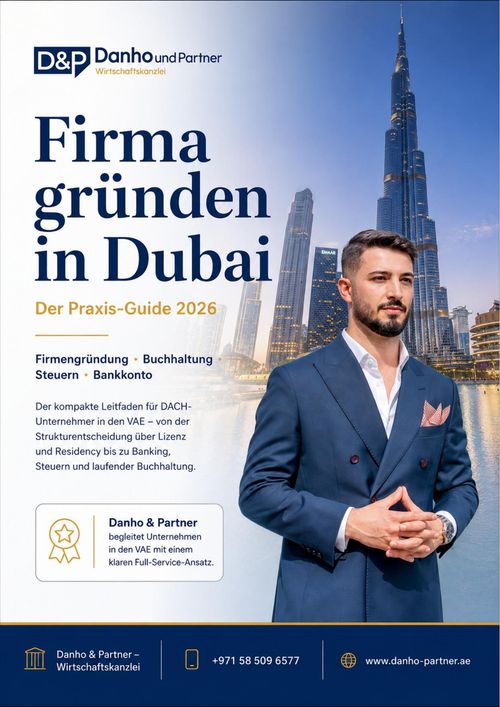
Firma gründen in Dubai 2026
25 Seiten zu Gründung, Buchhaltung, Steuern und Bankkonto in den VAE.
Mit dem Absenden stimmen Sie der Verarbeitung Ihrer Daten gemäß unserer Datenschutzerklärung zu. Abmeldung jederzeit möglich.
Talk to us
Get in touch to discuss your individual case. We offer detailed solutions tailored precisely to your needs.