What You Need to Know About Setting Up a Company in Dubai
For entrepreneurs from Germany, Austria and Switzerland, Dubai is one of the most sought-after locations for their own company. Many guides, however, still describe the legal situation before 2023: no corporate tax, free zones without VAT, formation without any physical presence. That is no longer accurate. This article shows you how setting up a company in Dubai works today, which taxes apply and which questions you should clarify before applying for a licence.
The key facts at a glance
- Individuals in the UAE pay no income tax on salaries, private investment income or private rental income.
- Companies have been subject to corporate tax for financial years starting on or after 1 June 2023: 0% on taxable profit up to AED 375,000 and 9% on the portion above.
- Value added tax (VAT) is 5%. Free zone companies are generally subject to VAT as well.
- You choose between mainland, free zone and offshore. The right form depends on your customers, your activity and your visa requirements.
- A company in Dubai does not change your tax liability in Germany as long as you keep your residence or habitual abode there.
Taxes in the UAE: what actually applies in 2026
No income tax for individuals
The UAE levies no income tax on salaries, private interest and dividends or private rental income. Individuals only fall within corporate tax if they themselves carry on a business with turnover of more than AED 1 million in a calendar year. More on this in our glossary entry Income tax exemption for individuals (German).
Corporate tax for companies
With Federal Decree-Law No. 47 of 2022, the UAE introduced a corporate tax. It applies to financial years beginning on or after 1 June 2023. Taxable profit up to AED 375,000 is taxed at 0%, the portion above at 9%. The threshold is a tax-free allowance: even if you earn more, the first AED 375,000 remain untaxed. An overview is provided in the glossary entry Corporate Tax UAE (German).
For small businesses there is Small Business Relief: if revenue in the relevant tax period and in all previous periods does not exceed AED 3 million, the company can elect to be treated as having no taxable income. Ministerial Decision No. 131 of 2026 extended the relief to tax periods ending on or before 31 December 2029. Qualifying Free Zone Persons and members of multinational enterprise groups are excluded.
Free zone does not automatically mean 0%
A free zone company can qualify as a Qualifying Free Zone Person and obtain a 0% rate on qualifying income. Conditions include adequate substance in the free zone, audited financial statements and compliance with the de minimis rule: non-qualifying income may not exceed 5% of revenue or AED 5 million, whichever is lower. Services to mainland customers are generally not qualifying. For many consultants, agencies and coaches, the standard rate with the tax-free allowance is therefore what counts, not the 0% rate.
VAT: 5%, in the free zone too
The UAE has levied VAT at 5% since 2018. Registration is mandatory once taxable supplies exceed AED 375,000 within twelve months, and voluntary registration is possible from AED 187,500. This generally applies to free zone companies as well. Special treatment exists only in so-called Designated Zones for certain supplies of goods, not for services. Services to customers abroad may be zero-rated if the conditions are met. Details in our article VAT in Dubai (German).
Substance, not a letterbox
The former Economic Substance Regulations have been repealed for periods beginning after 31 December 2022. Substance nevertheless remains important: for Qualifying Free Zone Person status, for the bank and above all for whether the tax office in your home country recognises the company. More on this under Economic substance (German).
Mainland, free zone or offshore
The UAE consists of seven emirates. What matters for your company formation is less the emirate than whether the company is registered on the mainland, in a free trade zone (free zone) or as an offshore company. A direct comparison can be found under Free zone vs. mainland (German).
| Criterion | Mainland | Free zone | Offshore |
|---|---|---|---|
| Licensing authority | in Dubai, the Department of Economy and Tourism (DET) | the respective free zone authority | offshore registry, e.g. RAK ICC or JAFZA |
| Business with customers in the UAE | unrestricted | restricted; on the mainland, depending on the activity, only via a distributor or an additional permit | not permitted |
| Residence visas | yes, depending on office space | yes, depending on the package | no |
| Office | physical office with a registered lease | from flexi-desk to dedicated office | registered agent only |
| Foreign ownership | 100% for most activities | 100% | 100% |
| Typical use | trade and services in the UAE, government contracts | international services, consulting, e-commerce, holding | holding participations and assets |
Mainland
A mainland company, usually an LLC, is licensed in Dubai by the Department of Economy and Tourism (DET, formerly DED). It may operate without restriction throughout the UAE and also supply government entities. Since June 2021, an Emirati majority shareholder is no longer required for most activities, and 100% foreign ownership is the rule. Exceptions apply to activities of strategic importance. More under Dubai mainland company formation.
Free zone
There are more than 40 free zones in the UAE, each with its own authority, list of permitted activities and pricing. Well-known examples in Dubai include Meydan Free Zone, DMCC and IFZA. Free zone companies can be 100% owned by the foreign founder, can issue visas and are particularly suited to internationally oriented services. Restrictions apply to direct business on the mainland. The process and choice of zone are described under Dubai free zone company formation; an overview of locations is given in our article Dubai Freezone (German).
Offshore
An offshore company, for example with RAK ICC or JAFZA, may not carry on any operating business in the UAE, run an office or apply for visas. It is mainly used for holding participations, real estate or intellectual property. A bank account is considerably harder to obtain for offshore companies than for free zone or mainland companies. More under Offshore company and in the glossary under Offshore company (German).
Special case: content creators
Anyone publishing advertising content from the UAE has needed, since 1 February 2026, the Advertiser Permit of the UAE Media Council in addition to a suitable trade licence. The National Media Council, formerly responsible, no longer exists in that form. Details in our article Influencer licence Dubai (German).
The process in eight steps
- Define your activity and customer base. This determines the choice between mainland and free zone and the specific licence activity.
- Choose the free zone or authority. Decisive factors are the permitted activities, the visa quota, office requirements and running costs.
- Reserve the name and obtain initial approval. The company name must comply with the authority's requirements.
- Submit documents. Passport, proof of address and, depending on the zone, further information. If a company is the founder, certified and, where required, apostilled corporate documents are needed.
- Receive the licence and company documents. These include the trade licence, articles of association and certificate of incorporation.
- Apply for visa and Emirates ID. Entry permit, medical examination, biometrics and issuance of the Emirates ID (German).
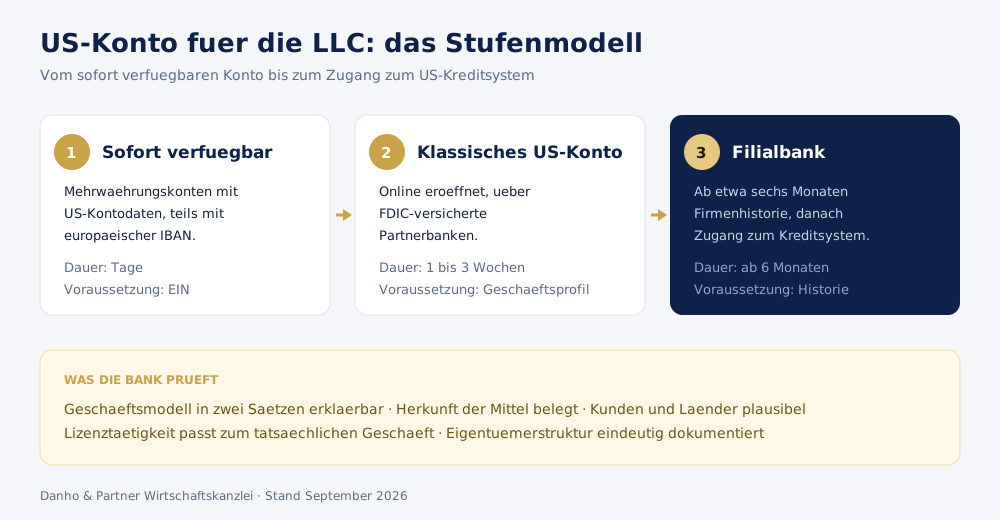
- Open a corporate account. The bank reviews the business model, shareholders and source of funds.
- Register for tax. Corporate tax within three months of incorporation, VAT once the threshold is reached.
Many free zones handle large parts of the process digitally. For the visa and usually also for the bank, however, you need to be there in person. Which documents are required is set out in our article Company formation in Dubai: requirements and documents (German).
Visa and residence
Through your company you can apply for a residence visa for yourself and, depending on the quota, for employees and family members. With the visa you receive the Emirates ID, which you need for a lease, a mobile contract and a personal bank account. For investors, entrepreneurs and specialists there is also the Golden Visa with a longer term.
Important: a visa alone does not move your tax residence. Whether you remain taxable in Germany depends on whether you keep a home or your habitual abode there. More under Dubai Residency.
Bank account for the company
In practice, the corporate account is often the most time-consuming step. Banks review the business model, the shareholders, the expected payment flows and the source of the initial capital. As a rule, at least one authorised signatory must be resident in the UAE. Some activities are not accepted by banks at all; you should clarify this before choosing the licence activity. More under Corporate bank account and in our articles Corporate account in Dubai without residency and Corporate account in Dubai rejected (German).
Ongoing obligations after formation
- Renew the licence annually and renew visas and Emirates IDs in good time.
- Register for corporate tax within three months of incorporation. Late registration incurs a penalty of AED 10,000.
- File an annual corporate tax return no later than nine months after the end of the financial year, even if no tax is due.
- Keep books in accordance with IFRS and retain records for seven years. Audited financial statements are mandatory, among others, for Qualifying Free Zone Persons and from AED 50 million in revenue.
- After VAT registration, file VAT returns regularly.
We handle these obligations as part of our accounting and corporate tax registration services.
The German side: what the formation does not settle
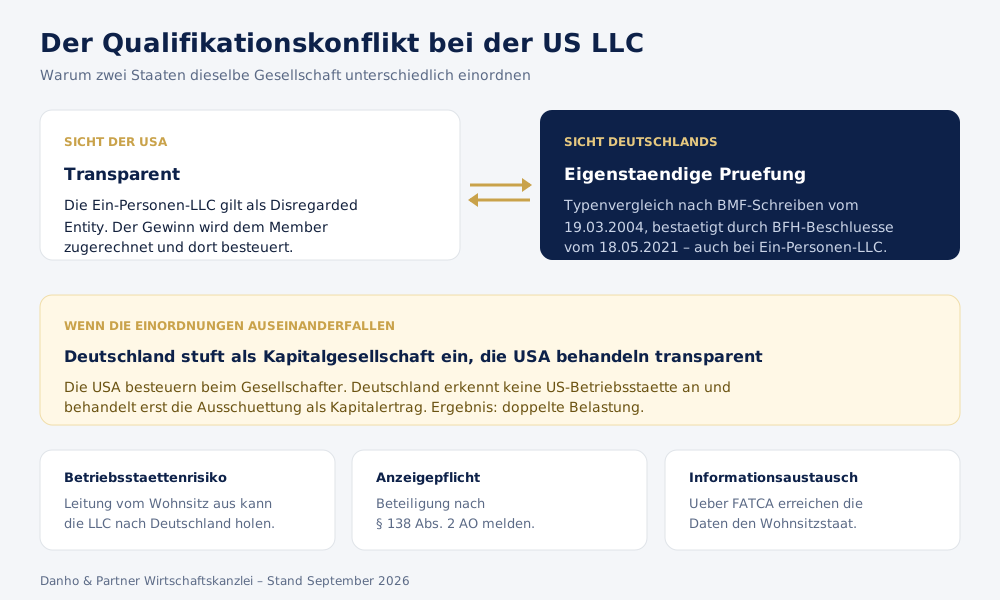
A company in Dubai is only half of the structure. As long as you live in Germany, you remain subject to unlimited tax liability there. If you manage the company from Germany, its place of effective management may be in Germany, with the result that it pays corporate income tax and trade tax there. For passive income, CFC taxation may also apply, and activity in Germany may create a permanent establishment (both German). There has been no double taxation agreement between Germany and the UAE since the end of 2021.
If you move to Dubai yourself, three points in particular need to be checked: exit taxation on shareholdings in corporations, extended limited tax liability and clean evidence of your new residence. Deregistering at the residents' registration office alone is not enough, as our article Deregistration from Germany (German) shows. For the German side, we work together with German tax advisers.
How much does setting up a company in Dubai cost?
The costs depend on the zone, the number of visas, the office model and the number of activities. In addition to the formation, annual costs arise for licence renewal, visas, accounting and the tax return. Flat figures without this information tend to be misleading. A three-year calculation can be found in our article Company formation in Dubai: costs (German), our packages on the page Company formation in Dubai (German).
Frequently asked questions
Is a company in Dubai tax-free?
Not automatically. Profits up to AED 375,000 remain untaxed; above that, 9% corporate tax applies. A 0% rate on the entire profit is only available through Small Business Relief or as a Qualifying Free Zone Person, each subject to conditions.
Do I have to live in Dubai to set up a company?
The formation itself does not require residence, and many steps can be completed remotely. For the visa and bank account, however, you need to be on site, and without a genuine relocation your tax liability in Germany remains.
Are free zone companies exempt from VAT?
No. Free zone companies are generally subject to VAT once they exceed the AED 375,000 threshold. Exceptions only concern certain supplies of goods in Designated Zones.
Do I need an Emirati partner?
Never in a free zone, and on the mainland no longer for most activities. Special rules continue to apply to certain activities of strategic importance.
How long does the formation take?
With complete documents, many free zones issue the licence within a few days to a few weeks. Visa, Emirates ID and corporate account take several additional weeks.
Book an initial consultation
For more than 7 years, Danho & Partner has supported entrepreneurs from the DACH region in setting up companies in the UAE, with more than 1,000 formations. In an initial consultation we clarify which form suits your activity, which taxes actually apply and what needs to be considered on the German side. Book an initial consultation now.
As of October 2026. This article is for general guidance only and does not replace individual tax or legal advice.

Firma gründen in Dubai 2026
25 Seiten zu Gründung, Buchhaltung, Steuern und Bankkonto in den VAE.
Mit dem Absenden stimmst du der Verarbeitung deiner Daten gemäß unserer Datenschutzerklärung zu. Abmeldung jederzeit möglich.
Talk to us
Get in touch to discuss your individual case. We offer detailed solutions tailored precisely to your needs.