Emigrating to Dubai: 5 Things to Consider Before You Relocate
Relocating to Dubai offers considerable benefits, and not only for companies. Every year, many German private individuals also move to the Emirate, a trend driven in part by Dubai's attractive tax model. In general, moving to the country is associated with a high standard of living and improved financial opportunities. However, to ensure that you can live free of concern in the United Arab Emirates, there are a number of formalities you should consider in advance, as they will be important when you relocate. You can find out what they are in the following overview:
Residence permit and Emirates ID
In order to live in Dubai, Abu Dhabi or one of the other 7 emirates for an extended period, you will need a residence permit (residence visa). This can most easily be obtained in the following four ways:
- Through a real estate investment of at least 5 million dirhams: Once you have purchased a property in the UAE, you can, as a real estate investor, apply for visas valid for 5 years. This visa grants you a right of residence, but not a work permit.
- By establishing a company
- With an investment of more than 10 million dirhams: This investment should remain in your name for at least 3 years, which gives you the opportunity to obtain a residence permit of up to 10 years.
- Through the Retirement Visa: If you are a pensioner, you can apply for a residence permit valid for 5 years. Your financial situation will be assessed accordingly, and the permit will be extended on that basis.
In any case, please note that in order to obtain a residence permit, you must first apply for an Emirates ID (an identification card) from the Emirates Identity Authority.
When applying for a residence visa as well as for an Emirates ID, we at Danho & Partner are glad to support you with our specialist expertise.
Taxes
The UAE, and Dubai in particular, is known for its tax exemptions. In Dubai, tax contributions such as income tax are largely waived, which is attributable to the city's economic boom. In addition, various types of income are also tax-exempt, such as salaries, pensions or capital income from real estate. Only a value added tax of 5% must be paid for certain companies. However, this tax regime changed as of June 2023: companies that exceed the annual turnover threshold of AED 375.00 now pay a tax rate of 9%.
As a private individual, however, you are exempt from this tax law. This is because income from private equity investments, real estate or the salaries of private individuals remains untaxed.
Healthcare
Whether you wish to emigrate alone or with your family, health and social insurance is likely one of the most important factors to consider when emigrating. This is because Germany and the UAE do not have a social security agreement, and the country (with the exception of Abu Dhabi) also does not have a statutory insurance system. As an immigrant, it is therefore advisable to take out international health insurance before you relocate. Irrespective of this, however, many foreign workers now make use of the services of private hospitals, as they do not have access to public facilities.
Housing
If you wish to emigrate to Dubai, you will sooner or later need to start looking for accommodation. There are, however, some significant differences compared to Germany: it is rather unusual to rent an apartment several months in advance. Instead, you often have to decide overnight whether or not you wish to take an apartment, because if life in Dubai is one thing, it is fast-paced and spontaneous.
You should also have a certain budget available for the monthly rent, as the city's luxurious and expensive buildings drive rental prices sharply upward. In some cases, you may also have to pay a full year's rent in advance. Against this background, it is therefore not unwise to invest in real estate over the long term and to purchase an apartment straight away, so that you can permanently save on housing costs.
Opening a bank account
When emigrating, you not only have to deregister from your country of departure for police and tax purposes. All banking arrangements must also be closed and reopened in Dubai or in one of the seven United Arab Emirates. To do so, you will need a residence permit as well as a “No Objection Certificate”, a salary confirmation from your employer. The remainder of the process is highly complex and, owing to the considerable bureaucratic effort involved, requires specialist expertise. Our experts at Danho & Partner can ensure exactly that.
Further benefits of relocating to the UAE
Many private individuals as well as entrepreneurs have already been won over by the way of life and the pleasant climate in Dubai. In addition, the major economic projects also speak in favour of relocating to the UAE, as they open up lucrative investment opportunities.
If you wish to emigrate with your family, the education system in Dubai will certainly be of interest to you. This is because the education system is one of the largest sectors in the country, one in which investments and expansion are made every year.
In addition, you will quickly meet like-minded people who can support you during your integration phase in the country, as there are currently around 12,000 German-speaking expatriates living in Dubai.
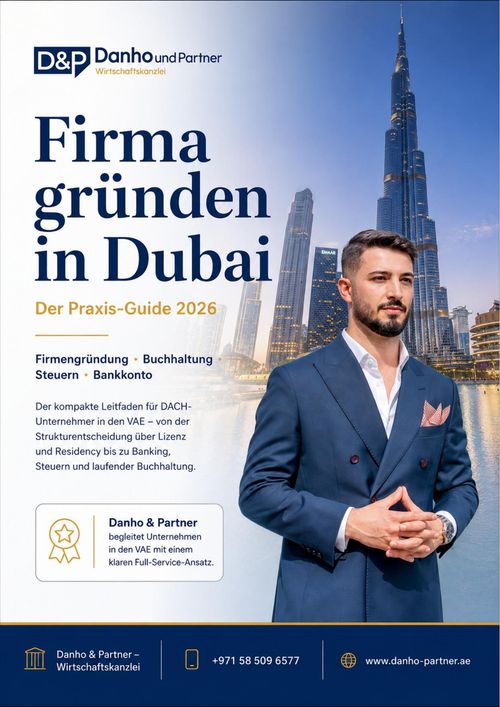
Firma gründen in Dubai 2026
25 Seiten zu Gründung, Buchhaltung, Steuern und Bankkonto in den VAE.
Mit dem Absenden stimmen Sie der Verarbeitung Ihrer Daten gemäß unserer Datenschutzerklärung zu. Abmeldung jederzeit möglich.
Talk to us
Get in touch to discuss your individual case. We offer detailed solutions tailored precisely to your needs.