Dubai Real Estate: Current Trends and Investment Opportunities 2025
Dubai Real Estate: Current Trends and Investment Opportunities 2025
Dubai real estate attracts investors and buyers from all over the world. The metropolis on the Persian Gulf is renowned for its impressive skyline and luxurious residential developments.

The Dubai real estate market offers a wide range of options, from exclusive villas to modern apartments in high-rise towers.
Dubai's strategic location as a hub between East and West makes the city an attractive base for international companies and private individuals. The real estate sector benefits from the stable economy and the ongoing diversification of the Emirates.
Investors value the tax-free returns and the favourable economic environment. Demand for real estate in Dubai continues to be driven by the influx of skilled professionals and the growing tourism industry. The market offers opportunities both for long-term investments and for short-term rental income.
Overview of the real estate market in Dubai
Dubai presents itself as a dynamic real estate market with a wide range of opportunities for investors and buyers. The metropolis offers an extensive choice of properties, from luxurious high-rise towers to exclusive villas.
The market is characterised by modern architecture and innovative projects. Sought-after areas such as Dubai Marina, Palm Jumeirah and Downtown Dubai are known for their prestigious addresses and high-quality apartments.
Foreign investors enjoy full ownership rights in certain freehold zones. This makes Dubai an attractive destination for international real estate transactions.
Prices vary significantly depending on the location and type of property. Luxury properties in prime locations command top prices, while more affordable options can be found in up-and-coming districts.
The market is subject to cyclical fluctuations, influenced by global economic trends and local developments. Regulators such as the Dubai Land Department ensure transparency and security in transactions.
Rental properties are also in strong demand, particularly among the large expatriate community. Short-term rentals are becoming increasingly important, driven by booming tourism.
Recent urban development projects are continually expanding the available supply of real estate. Sustainability and smart home technologies are playing a growing role in modern construction projects.
Investment Opportunities
Dubai offers a wide range of real estate investment opportunities. The market is diverse and dynamic, with options for various investor profiles and budgets.
Residential Real Estate
Luxury apartments in Dubai Marina and Palm Jumeirah are particularly sought after. They promise high rental yields and significant potential for appreciation.
Family-friendly villas in communities such as Arabian Ranches and Jumeirah Park are growing in popularity. They offer privacy and often spacious gardens.
More affordable options can be found in up-and-coming neighbourhoods such as Dubai South. New residential developments with modern amenities are being built here.

Commercial Real Estate
Office space in central business districts such as Downtown Dubai and DIFC is in high demand. Such properties attract international companies and promise stable rental income.
Retail spaces in popular shopping centres offer considerable potential. The Mall of the Emirates and Dubai Mall are examples of successful retail investments.
Warehouses and logistics centres are gaining in importance. Locations near Jebel Ali Port or Al Maktoum International Airport are strategically situated.
Off-plan Real Estate
Investing in projects before construction begins can offer attractive prices. Many developers offer flexible payment plans.
Large-scale developments such as Dubai Creek Harbour promise future growth. Early investors can benefit from increases in value.
It is important to verify the developer's reputation. Established companies such as Emaar or Nakheel are considered reliable.
Real Estate Resale
The market for existing properties is active. Many properties offer potential for renovation and value enhancement.
Older districts such as Deira or Bur Dubai have their own charm. They can offer more affordable ways to enter the market.
Well-maintained properties in established areas can often be rented out quickly. This can be of interest to investors seeking immediate rental income.
Legal Framework
The real estate market in Dubai is subject to specific legal regulations. These govern property rights, residence permits and contractual aspects for foreign investors.

Property Rights
Foreigners can acquire real estate as freehold property in certain areas of Dubai. These zones include well-known developments such as Palm Jumeirah and Dubai Marina.
In other areas, only leasehold ownership is possible, with leases of up to 99 years. The precise rights vary depending on location and property type.
The Dubai Land Department registers all real estate transactions. It issues official title documents that establish legal ownership.
Visas and Residence Permits
Real estate investors can apply for an investor visa. This enables a longer-term stay in the United Arab Emirates.
The minimum investment for a 3-year visa is AED 1 million. A 5-year visa requires AED 5 million. The 10-year visa requires an investment of AED 10 million.
The property must be paid for in full and free of debt. In addition, it must not be rented out in order to qualify for the visa.
Contract Drafting and Legal Due Diligence
Purchase contracts for real estate in Dubai follow standardised templates. These are provided by the Dubai Land Department and are legally binding.
A careful review of all documents is essential. This includes proof of ownership, building permits and any encumbrances on the property.
The assistance of a local lawyer is recommended. A lawyer can carry out legal due diligence and advise on the drafting of contracts.
All contracts must be drawn up in Arabic. A certified translation into other languages is possible.
Financing and Investments
The real estate market in Dubai offers a wide range of financing options for investors. These range from traditional bank loans to Islamic financing products and specialised investment funds.
Bank Financing
Numerous local and international banks in Dubai offer real estate loans. Interest rates are often competitive, typically between 3% and 5% per year. Terms vary from 15 to 25 years.
Special conditions apply to foreign nationals. You usually have to make a higher down payment, often 30% to 40% of the purchase price. Some banks also require life insurance as additional security.
Creditworthiness is rigorously assessed. Banks usually require proof of income, bank statements and, in some cases, guarantees.
Islamic Financing
Islamic financial products are becoming increasingly important in Dubai. These products are based on Shariah principles and avoid interest.
One popular option is Murabaha financing. Here, the bank purchases the property and sells it on to the customer at a profit margin. Repayment is made in instalments.
Ijara, an Islamic lease, is also common. The customer leases the property from the bank and acquires it gradually.
Investment Funds
Real estate funds offer an alternative to direct investment. They enable investors to participate in the market with a smaller capital outlay.
There are open-ended and closed-ended funds. Open-ended funds allow flexible entry and exit. Closed-ended funds often offer higher returns but require longer commitment periods.
REITs (Real Estate Investment Trusts) are gaining popularity in Dubai. They offer investors the opportunity to invest in a diversified real estate portfolio.
Many funds specialise in specific types of real estate, such as office buildings or residential complexes. This allows investors to target their strategy precisely.

Tax Advice and Costs
Purchasing real estate in Dubai involves various tax aspects and costs. These include the property transfer tax, annual tax obligations and additional ancillary purchase costs.
Property Transfer Tax
In Dubai, the property transfer tax, also known as the “transfer fee,” amounts to 4% of the purchase price. This fee is usually split between buyer and seller, with each party paying 2%. For new builds, the entire fee may be borne by the buyer.
Payment is made upon transfer of ownership at the Dubai Land Department. Different rates may apply for certain areas or projects.
Annual Tax Obligations
Dubai does not levy income tax on rental income. However, owners must pay an annual fee for municipal services. This amounts to 5% of the annual rent, or of the estimated rental value for owner-occupied properties.
Additional fees may apply to commercial properties. It is advisable to check the current regulations, as they may change.
Additional Purchase Costs
In addition to the property transfer tax, there are further costs:
- Brokerage fee: usually 2% of the purchase price
- Notary fees: around AED 4,000
- Land registration: AED 250 for apartments, AED 4,000 for villas
Buyers should also budget for due diligence costs. Financing involves fees for appraisals and processing.
Thorough planning and professional advice help to avoid unexpected expenses and ensure a smooth purchase process.
Market Trends and Analysis
The real estate market in Dubai is dynamic and diverse. Luxury real estate continues to be highly popular with international investors. Demand for high-quality apartments and villas in exclusive locations remains consistently strong.
At the same time, sustainable construction projects are gaining in importance. Energy-efficient buildings and environmentally friendly technologies are increasingly becoming the standard in new developments.
The rental market is stabilising following the fluctuations of recent years. Rents in popular residential areas such as Dubai Marina and Downtown Dubai are rising moderately.
Current Price Development:
Property type — average price increase (2024)
Apartments 5.8%
Villas 7.2%
Office space 3.5%
Investors are showing increased interest in up-and-coming districts such as Dubai South and Meydan. These areas promise attractive returns thanks to their strategic location and planned infrastructure developments.
The digitalisation of the real estate market is advancing. Online platforms and virtual tours facilitate the buying and selling process for all parties involved.
Location Analysis and Infrastructure
Dubai offers a variety of attractive residential areas and a constantly evolving infrastructure. The city invests continuously in new projects and transport links.
Popular Neighbourhoods
Downtown Dubai is one of the most sought-after residential areas. The Burj Khalifa and Dubai Mall are located here. The artificial island of Palm Jumeirah attracts residents with beach villas and luxury apartments. Dubai Marina impresses with its marina and skyscrapers.
Jumeirah Beach Residence (JBR) is popular with beach lovers. The historic district of Deira offers traditional souks and affordable housing. Business Bay is developing into a new business centre with modern residential towers.

Transport and Transport Links
Dubai's transport network is constantly growing. The Dubai Metro connects key areas of the city. It comprises two lines with 49 stations. Buses complement the public transport network.
Taxis are widely available and affordable. Road construction is progressing, with new bridges and tunnels being built. Dubai International Airport handles over 80 million passengers a year.
Future Development Projects
Dubai is planning ambitious construction projects. Dubai Creek Harbour is set to become a new city centre with the tallest tower in the world. Exclusive resorts are being built on the artificial archipelago “The World.”
The Dubai South project includes the new Al Maktoum International Airport. It is intended to provide living space for one million people. The Dubai Water Canal is creating new waterfronts and leisure opportunities.
Property Management and Services
Professional property management is critical to the long-term success of real estate investments in Dubai. It covers various aspects, from letting to maintenance.
Letting and Administration
Letting property in Dubai requires in-depth market knowledge. Experienced property managers carry out market analyses to set optimal rental prices. They handle finding tenants, credit checks and the conclusion of contracts.
Administration includes rent billing, utility charges and communication with tenants. Property managers act as points of contact for all matters and resolve any conflicts professionally.
Regular inspections of properties ensure that they retain their value. Compliance with local laws and regulations is monitored to avoid legal problems.
Maintenance and Repair
Regular maintenance is essential to preserve the value of the property and to keep tenants satisfied. Property managers coordinate routine work such as cleaning, gardening and technical inspections.
When repairs are required, they engage qualified tradespeople and supervise the work. A network of reliable service providers enables faster response times in emergencies.
Preventive maintenance helps avert major damage. Property managers prepare maintenance schedules and budgets for upcoming renovations or modernisations.
They advise owners on worthwhile investments that can increase the value of the property. This may include energy-efficient renovations or upgrades to fixtures and fittings.
Sustainability and Environmentally Friendly Construction
Dubai is increasingly focusing on sustainable construction methods. Innovative technologies and green concepts are finding their way into the metropolis's real estate sector.
Energy-efficient buildings with solar panels and intelligent climate systems reduce energy consumption. Water-saving installations and greywater recycling help to conserve scarce water resources.
Green façades and roof gardens improve the microclimate and provide additional living space in the desert city. Some projects incorporate vertical gardens, which contribute to air purification and cooling.
Sustainable building materials such as recycled steel and local resources minimise the ecological footprint. Certification systems such as LEED set standards for environmentally friendly construction in Dubai.
The government promotes this development through strict building regulations and incentives for green real estate. By 2030, the majority of new buildings are expected to meet sustainable criteria.
Innovative projects such as “The Sustainable City” demonstrate the practical implementation of holistic eco-concepts. This self-sufficient community uses renewable energy and promotes a sustainable lifestyle.
Despite this progress, the challenge remains to reconcile sustainability with the city's rapid growth. Experts still see potential for improvement in recycling and waste management.

Future Prospects of the Real Estate Market in Dubai
The real estate market in Dubai remains dynamic and promising. Experts predict continued growth in the coming years. Demand for both residential and commercial properties is expected to rise.
Major infrastructure projects such as Expo 2020 have increased Dubai's appeal as an investment location. This is likely to have a positive effect on the real estate market. Investors are showing growing interest in sustainable and technologically advanced buildings.
The government is planning further measures to promote the real estate sector. These include:
- Simplifying approval procedures
- Tax incentives for investors
- Promotion of environmentally friendly construction projects
Experts expect prices in established residential areas to stabilise. There could be moderate increases in value in up-and-coming districts. The luxury real estate market is expected to remain robust.
Increasing digitalisation is set to continue transforming the real estate market. Virtual viewings and AI-based analytics are becoming increasingly important. This could make the buying process easier for international investors.
Despite these positive prospects, challenges remain. The global economic situation and geopolitical factors can influence the market. A balanced development of supply and demand will be crucial.
Frequently Asked Questions
The real estate market in Dubai raises many questions for foreign investors. From legal aspects to return expectations, there are numerous important points to consider.
What is the process for buying an apartment in Dubai as a foreigner?
Foreigners can acquire real estate as freehold property in certain areas of Dubai. The buying process begins with the selection of the property and price negotiations. A purchase contract is then drawn up and a deposit is paid.
After verification of the documents, the transfer of ownership takes place at the Dubai Land Department. The remaining purchase price is paid there and the property is registered.
What legal aspects do Germans need to consider when buying real estate in Dubai?
German buyers should familiarise themselves with local real estate laws. Dubai has special freehold zones for foreign owners.
A local lawyer can assist with drafting a legally secure contract. Tax aspects, such as any double taxation agreements between Germany and the UAE, are also important.
What is the average cost of a property in Dubai?
Prices vary significantly depending on the location and type of property. Apartments in central locations start at around 200,000 euros. Villas in exclusive areas can cost several million.
There are also additional costs such as brokerage fees, land registration and, where applicable, taxes. These usually amount to 5–7% of the purchase price.
What factors should be considered when investing in real estate in Dubai?
Important factors include the location, infrastructure and future development plans of the area. The quality of the building and the developer plays a major role.
Rental potential and possible increases in value should also be analysed. The political and economic stability of the region must likewise be taken into account.
What are the average returns on real estate investments in Dubai?
The rental yield in Dubai is usually between 5% and 8% per year. Higher returns are also possible in some areas.
Depending on the market situation and the location of the property, increases in value can generate additional profits. Historically, the market has grown over the long term, though it has also been subject to fluctuations.
Which areas in Dubai offer the best potential for real estate investment?
Downtown Dubai and Dubai Marina are regarded as established prime locations with stable values. Emerging areas such as Dubai Hills Estate or Mohammed Bin Rashid City offer growth potential.
New developments such as Dubai South, around the new airport, are also of interest to investors. The choice depends on individual investment objectives and risk appetite.
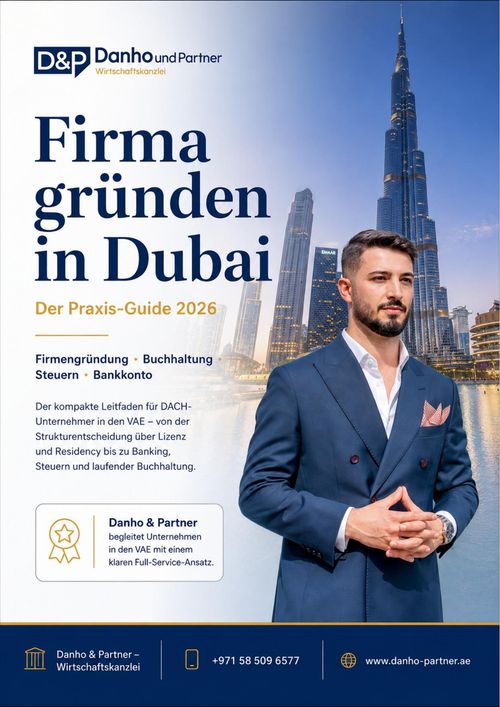
Firma gründen in Dubai 2026
25 Seiten zu Gründung, Buchhaltung, Steuern und Bankkonto in den VAE.
Mit dem Absenden stimmen Sie der Verarbeitung Ihrer Daten gemäß unserer Datenschutzerklärung zu. Abmeldung jederzeit möglich.
Talk to us
Get in touch to discuss your individual case. We offer detailed solutions tailored precisely to your needs.